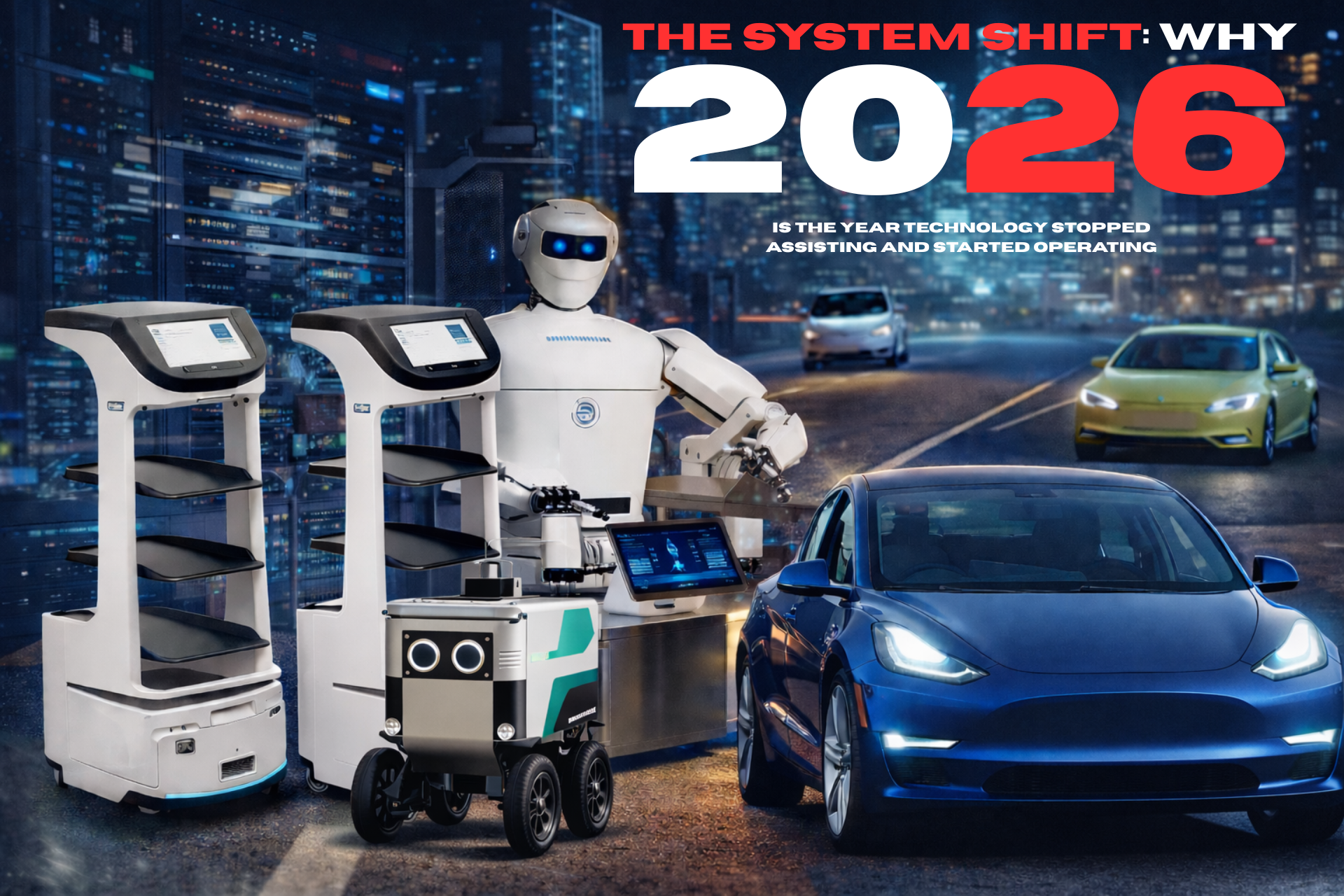
2026 is not defined by new tools.
It is defined by a structural shift in how technology functions.
For years, digital systems have been positioned as assistants — tools designed to respond to input, complete tasks, and improve efficiency at the direction of the user. That model is no longer the center of innovation.
What is emerging now is a different class of system entirely.
Systems are no longer waiting.
They are beginning to act.
From Assistance to Execution
The first wave of modern AI focused on interaction.
Users prompted. Systems responded.
Tasks were completed, but control remained firmly with the user.
That layer still exists — but it is no longer the most important one.
AI is now being embedded into operational environments where it does not wait for instructions. Instead, it participates in execution.
It is being integrated into:
- Workflow management systems that organize and trigger processes automatically
- Decision-routing layers that prioritize actions based on real-time data
- Operational infrastructures that continuously optimize performance
This represents a shift from interaction-based technology to execution-based systems.
The user is no longer initiating every action.
In many cases, the system already has.
The Emergence of Continuous Systems
Traditional digital environments were reactive by design.
They depended on:
- Manual updates
- Triggered inputs
- Periodic adjustments
Modern systems are moving toward continuous operation.
They monitor, adjust, and optimize without requiring direct engagement.
This creates a new category of system — one that is not “used” in the traditional sense, but relied on as an active layer of operation.
Why This Shift Is Happening Now
This transition is not sudden. It is the result of multiple layers maturing at the same time.
1. Infrastructure Has Reached Stability
Cloud environments, distributed systems, and scalable hosting have reached a point where continuous operation is sustainable.
Systems can now run without interruption, handling load, traffic, and complexity without degrading.
2. AI Models Have Become Reliable Enough to Deploy
Earlier models were experimental.
Current systems are stable enough to:
- Execute decisions
- Handle structured tasks
- Operate within defined constraints
This reliability has allowed AI to move from testing environments into real systems.
3. Data Pipelines Have Expanded
Modern systems are no longer limited by lack of input.
They are fed by:
- User behavior
- System performance data
- External signals
This allows continuous adjustment rather than delayed reaction.
The Impact on Digital Environments
The effect of this shift is already visible.
Websites, platforms, and businesses are no longer static structures.
They are becoming adaptive systems.
Instead of:
- Manual optimization
- Reactive updates
- Periodic maintenance
We are seeing:
- Automated performance tuning
- Predictive system behavior
- Continuous operational adjustment
This changes how digital assets are built, managed, and scaled.
The Illusion of Control
One of the most overlooked aspects of this shift is perception.
Users still feel in control — because interfaces remain familiar.
But behind those interfaces, systems are making decisions, prioritizing actions, and shaping outcomes before the user becomes aware of them.
This introduces a new dynamic:
Control is no longer about direct input.
It is about how well a system has been structured to operate on its own.
What This Means Going Forward
The next phase of digital development will not be defined by more features or faster tools.
It will be defined by:
- Systems that require less intervention
- Environments that optimize themselves
- Platforms that operate continuously
The competitive advantage will shift from who can use tools best to who can build systems that operate effectively without constant input.
Final Perspective
The shift happening now is not about improving assistance.
It is about reducing the need for it.
Technology is no longer something you actively use at every step.
It is becoming something that operates — continuously, quietly, and increasingly independently.
And the systems that embrace this shift will not just perform better.
They will define the next standard of how digital environments function.