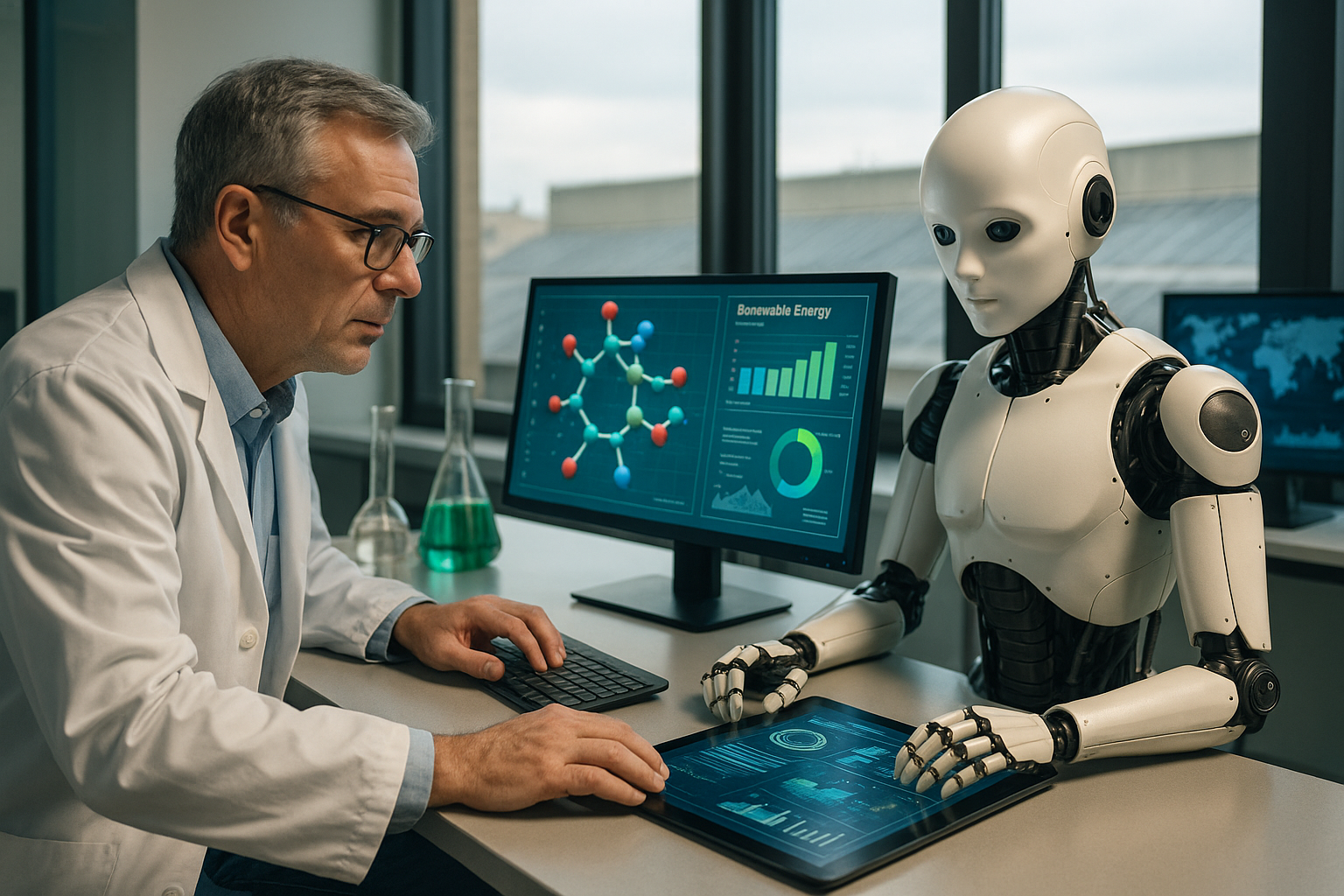
The Convergence Frontier: How Tech Is Merging Across Domains
For decades, technological progress happened in silos: computer scientists built software, chemists improved materials, and biologists studied life. But 2025 marks a shift. The most disruptive advances now emerge at the intersections of these once-separate disciplines. This phenomenon—known as tech convergence—is rapidly reshaping everything from healthcare and manufacturing to climate science and computing.
As the World Economic Forum notes, “the boundaries between digital, physical, and biological systems are collapsing.” Instead of isolated inventions, the future of tech innovation is built on integration.
The Convergence Catalyst: AI Everywhere
These AI-driven intersections—AI plus biology, AI plus materials, AI plus energy—are creating synergies once thought impossible. As McKinsey & Company reports, more than 60 percent of R&D leaders say AI is now a core component of their scientific workflows.
AI + Biology: The Birth of Computational Life Science
-
Drug Discovery: Companies like DeepMind’s AlphaFold and Insilico Medicine are using AI to predict protein folding and identify drug targets for cancer and neurodegenerative diseases.
-
Personalized Medicine: AI integrates genetic, lifestyle, and environmental data to recommend treatments tailored to each individual.
-
Synthetic Biology: Startups such as Ginkgo Bioworks use machine learning to engineer microbes for bio-based materials and fuels.
According to a Stanford Bioengineering report, AI-powered biological design could cut R&D cycles by 70 percent and unlock entirely new classes of therapies.
AI + Materials Science: Smarter Matter
-
Clean Energy: AI is helping identify materials for carbon capture and hydrogen storage.
-
Construction: Self-healing cement and climate-adaptive materials are emerging from university labs in Europe and Asia.
-
Consumer Tech: Flexible, biodegradable electronics are entering commercial testing.
The European Commission’s Materials 2030 Roadmap highlights that AI models have reduced materials discovery time by up to 90 percent compared to traditional methods.
Energy + Computation: The Sustainable Loop
Quantum + AI: The Next Computing Revolution
Quantum computing and AI represent two frontiers that reinforce each other. AI helps design quantum algorithms and error-correction systems, while quantum hardware may one day turbocharge AI training and reasoning.
Convergence in Healthcare and Industry
Beyond labs and theories, real-world applications are accelerating.
-
Healthcare: AI models paired with medical imaging and biotech enable earlier detection of diseases like Alzheimer’s and lung cancer.
-
Manufacturing: Factories use AI-driven robotics to adapt production lines in real time, reducing waste and energy consumption.
-
Agriculture: Biotech and IoT sensors combine to monitor soil health and reduce fertilizer use through precision delivery systems.
As the OECD Science Report notes, cross-disciplinary innovation is no longer optional — it’s the defining feature of modern research ecosystems.
Challenges: Integration and Ethics
The Economic Impact of Convergence
The World Bank projects that by 2030, convergent tech industries could represent more than 15 percent of global GDP. Early adopters stand to gain the most through intellectual property and data ownership.
How Organizations Can Prepare
To thrive in the convergence era, companies and governments should:
-
Foster cross-disciplinary R&D. Merge engineering, life sciences, and data teams to accelerate discovery.
-
Invest in data infrastructure. Unified data lakes enable AI to draw insights across domains.
-
Develop agile regulation. Policies must adapt faster to new hybrid technologies.
-
Train interdisciplinary talent. Promote programs that combine AI, biology, and physics curricula.
-
Collaborate globally. Convergence is a shared endeavor that thrives on international research networks.
Conclusion
If the 20th century was the age of specialization, the 21st belongs to integration — a world where the frontier of innovation lies between disciplines, not within them.
References