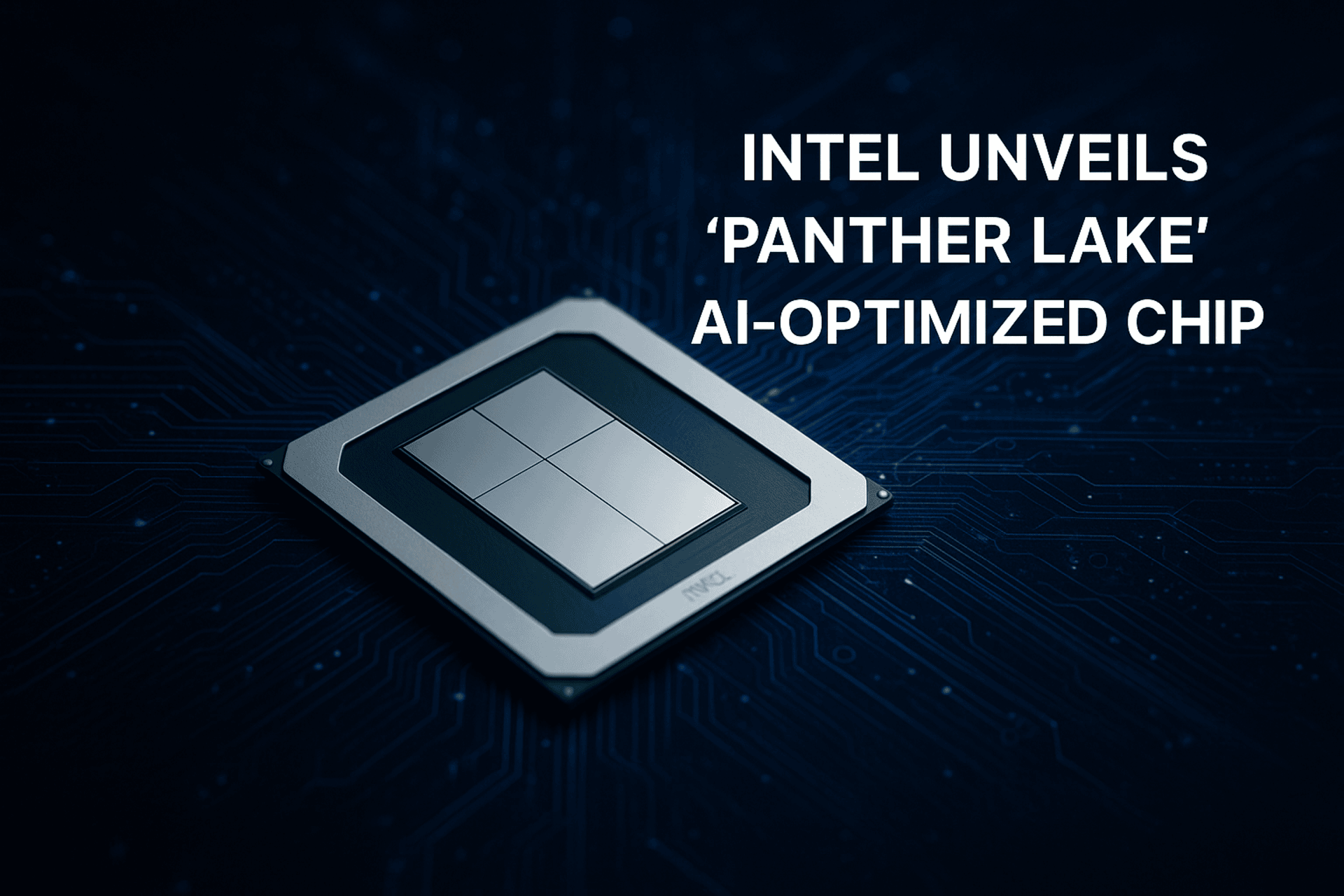
Intel Unveils “Panther Lake”: Its First AI-Optimized PC Chip Built on New Manufacturing Tech
Intel’s Big AI Bet
Intel announced details of its Panther Lake processor this week, describing it as the company’s first PC chip built with its 18A manufacturing process, a next-generation node that represents Intel’s most advanced semiconductor design in years.
According to Reuters, the chip will begin shipping in 2026 laptops and is engineered for AI-accelerated performance directly on the device, rather than relying on cloud computing resources.
The development marks a crucial milestone for Intel’s long-term strategy to reclaim its dominance in the global semiconductor industry, where it faces growing competition from TSMC, Samsung, and AMD.
18A Manufacturing Process: A New Foundation
Intel’s 18A process represents a leap forward in chip fabrication. It uses new transistor and power-delivery technologies that improve energy efficiency and computing power.
The “18A” designation refers to the company’s angstrom-scale technology—roughly 1.8 nanometers—placing Intel back in direct competition with TSMC’s most advanced nodes.
According to Intel executives, the 18A node introduces:
-
RibbonFET transistors, Intel’s first new transistor architecture since FinFET.
-
PowerVia technology, which delivers power through the backside of the wafer for greater efficiency.
-
Enhanced AI and GPU integration that allows the chip to process machine learning tasks locally.
Intel claims that Panther Lake will deliver up to 50% higher performance per watt compared to its predecessor, Lunar Lake, which debuted earlier this year.
AI on the Device, Not in the Cloud
A key feature of Panther Lake is its on-device AI acceleration.
As more consumer and enterprise applications rely on generative and predictive AI, Intel is betting that personal computers will need stronger local processing power to handle tasks privately and securely—without always depending on cloud servers.
In a statement reported by Reuters, Intel said that Panther Lake “will deliver new AI capabilities directly to PCs,” allowing users to run complex AI models for productivity, creative work, and local data analysis.
This approach mirrors recent industry moves toward “AI PCs”, where major players like Microsoft, AMD, and Qualcomm have also announced AI-enhanced laptop chips to support next-generation Windows and productivity tools.
Global Competition Heats Up
Intel’s new chip comes at a time when semiconductor competition is intensifying.
TSMC continues to lead global chip production, manufacturing advanced processors for Apple, NVIDIA, and AMD. Meanwhile, Samsung has ramped up its foundry investments to challenge both companies in AI hardware.
Intel’s advantage lies in its integrated design and manufacturing model, allowing it to develop chips and produce them in-house.
The company plans to expand its foundry services to other chipmakers through Intel Foundry, its revived manufacturing division.
As part of its roadmap, Intel aims to achieve five new manufacturing nodes in four years—a pace designed to reestablish the United States as a leader in advanced chipmaking.
Industry Response
Analysts have reacted positively to Panther Lake’s debut, describing it as a “proof point” that Intel’s turnaround strategy is on track.
Patrick Moorhead, CEO of Moor Insights & Strategy, told the Financial Times that “Intel’s success with 18A could be the inflection point where it begins closing the performance and efficiency gap with TSMC.”
However, industry observers caution that execution remains critical. Intel has struggled with manufacturing delays in past years, and maintaining consistent yield rates at 18A scale will determine whether the company can meet production and performance targets.
What It Means for Consumers
For PC users, Panther Lake promises tangible improvements:
-
Better AI features in everyday applications such as photo editing, voice recognition, and productivity tools.
-
Longer battery life thanks to improved energy efficiency.
-
Enhanced graphics and media performance through unified CPU-GPU architecture.
If successful, Panther Lake could redefine what “personal computing” means—moving from simple processing to on-device intelligence that learns, predicts, and adapts.
A Step Toward the AI-First Future
Intel’s new processor is more than a performance upgrade; it’s a signal that the AI-first computing era has arrived.
As chipmakers compete to bring generative and adaptive AI to personal devices, the focus is shifting from raw speed to intelligence, privacy, and autonomy.
Panther Lake may be Intel’s strongest statement yet that it intends to lead this transition—if it can execute on its ambitious roadmap.
References
-
Reuters: Intel outlines details of first PC chip made on its new manufacturing tech (2025)
-
Financial Times: Intel’s 18A ambitions and market positioning