-
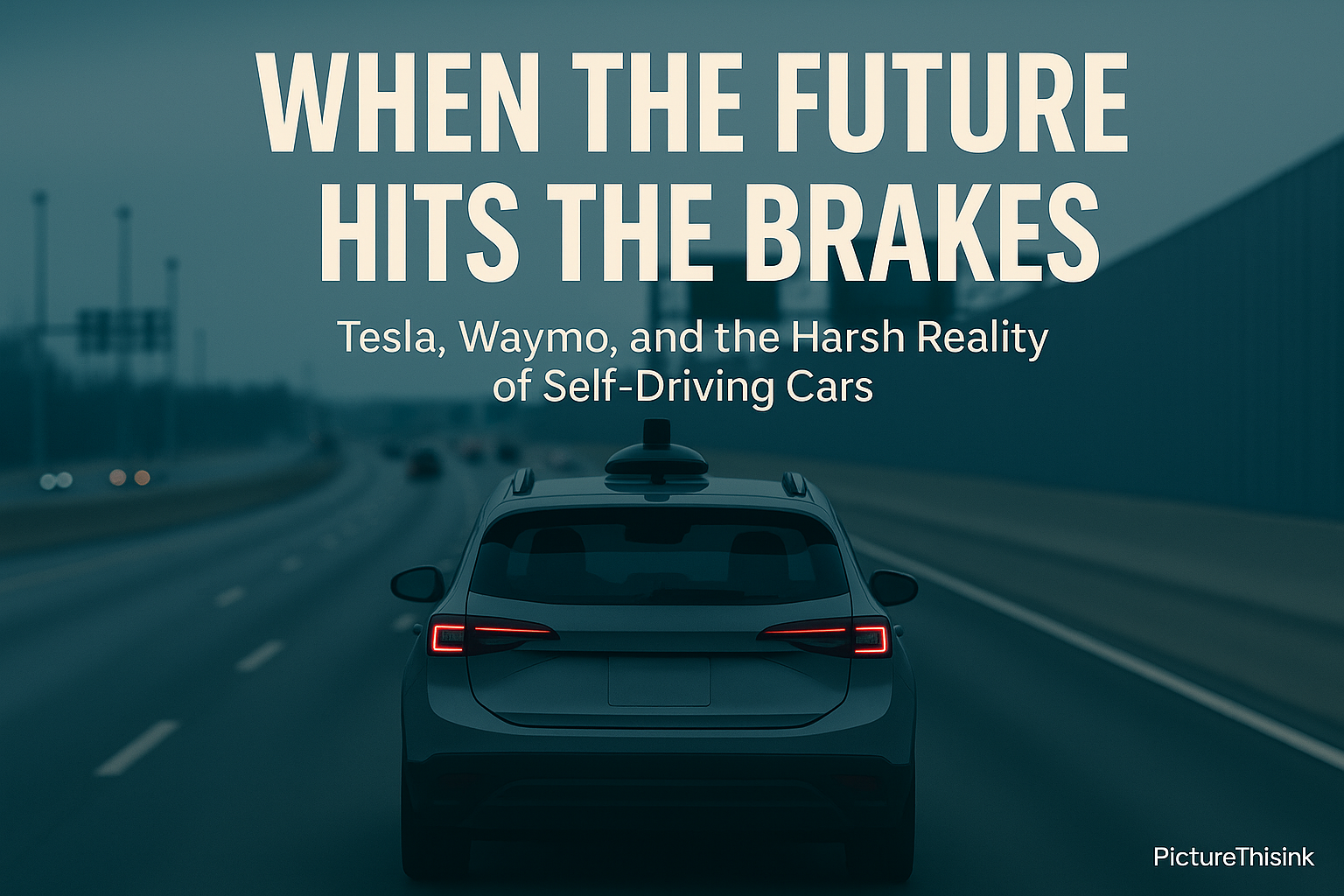
When the Future Hits the Brakes
Tesla, Waymo, and the Reality Check for Robot Cars
By PictureThisInk · Tech & Innovation CommentaryUpdated: October 28 2025
Editorial Disclaimer
This article represents commentary and analysis based on publicly available information.PictureThisInk does not make or imply factual allegations beyond those cited from verifiable sources.
The dream was simple: no steering wheels, no accidents, no stress.
A decade ago, self-driving cars were supposed to redefine mobility and eliminate human error.Yet as 2025 draws to a close, that dream is sputtering at the intersection of hype and hard reality.Once viewed as the crown jewel of artificial intelligence, autonomous vehicles (AVs) are now a cautionary tale — slowed by lawsuits, technical failures, and shaken public trust.
From Fast Lane to Holding Pattern
After billions in investment and years of testing, even the leaders are hitting speed bumps.
Waymo, Alphabet’s autonomous-driving arm, recently announced it would return to manual testing at Newark Liberty International Airport in collaboration with the Port Authority of New York and New Jersey (Economic Times Auto, Oct 2025).That means human safety drivers are back behind the wheel — not exactly the vision of a driverless future.Meanwhile, Tesla Inc. was ordered to pay US $243 million in damages over a fatal crash involving its Autopilot feature — the largest such verdict to date (EV Magazine, Oct 2025).The ruling jolted Silicon Valley investors and underscored a truth engineers have long voiced: autonomy is far harder — and riskier — than marketing implies.
The Technology Isn’t Broken — It’s Just Not Ready
Driving is not only reaction but interpretation. Humans make eye contact, gesture, and anticipate chaos — something code still can’t replicate.
Despite LiDAR, radar, and multi-camera fusion, AVs still misread the road.A University of Minnesota study found that “phantom braking” — abrupt stops for non-existent obstacles — remains common, causing rear-end collisions and eroding user trust (Land Line Media, Oct 2025).Even mundane issues — faded paint, heavy rain, work zones — can confuse sensors.When machines hesitate, human drivers react instinctively, sometimes with disastrous timing.
The Human Factor
One of the hardest problems isn’t mechanical — it’s psychological.Humans don’t drive by code; we drive by courtesy, habit, and local culture.As Government Technology notes, AVs “follow the letter of the law but miss the unwritten rules of the road,” creating friction when humans bend those rules (GovTech, 2024).
Until software understands social intent, full autonomy will remain a moving target.
Legal Limbo
The National Highway Traffic Safety Administration is investigating roughly 2.4 million Teslas equipped with “Full Self-Driving” following reported collisions (Reuters, Oct 2025).
Liability laws lag behind automation. If an algorithm misreads a cyclist, is the blame on code, design, or the supervising driver?Legal analyst Alison Frankel wrote that “driverless-car problems are outpacing liability laws” (Reuters Legal, 2023).Until legislators define responsibility, each crash will be precedent in motion.
The Trust Deficit
Public sentiment may be the biggest roadblock.
After Cruise’s robotaxi dragged a pedestrian in San Francisco, regulators suspended its U.S. operations (Wikipedia, 2025).Only 13 percent of Americans say they would trust a fully driverless car (W. Lockett, Medium 2025).Even Waymo co-CEO Tekedra Mawakana acknowledged that “society will eventually have to accept a death caused by a robotaxi” (SFGate, Oct 2025).It’s a frank admission — and a reminder of how public trust defines adoption.
Business Reality
Start-ups once promised fleets by 2020, then 2022. Investors are growing cautious.
Reports suggest Tesla may scale back its Dojo supercomputer, once touted as the key to autonomy breakthroughs (Seeking Alpha, Oct 2025).Analysts at Guidehouse Research still see potential but note that “recalls and regulatory scrutiny will slow adoption” (PR Newswire, 2025).The AV revolution isn’t dead — just expensive, litigious, and delayed.
The Bigger Picture
Robot cars mirror a broader truth in tech: ambition outpaces adoption.
Generative AI faces copyright battles, crypto faces regulation, and wearables face privacy limits.Each frontier meets friction when the world pushes back.Innovation doesn’t fail because it slows — it matures because it must.
The Road Ahead
Despite turbulence, progress continues.Waymo, Cruise, Zoox, and Tesla keep refining perception models and redundancy systems.The U.S. Department of Transportation is updating safety standards for vehicles without steering wheels or pedals (CBT News, 2025).Limited-scope deployments — airports, campuses, industrial zones — may define the next realistic phase.The dream lives on, just closer to the curb.
PictureThisInk Commentary
The autonomous-vehicle story isn’t about failure; it’s about adjustment.Progress is real — simply slower, wiser, and more accountable.Every transformative industry disappoints before it delivers.That’s not decline; that’s maturity.And maturity is where real innovation begins.
Verified References (Checked Oct 2025)
-
Economic Times Auto – Waymo manual testing (Oct 2025)
-
EV Magazine – Tesla Autopilot verdict (Oct 2025)
-
Land Line Media – Phantom braking study (Oct 2025)
-
GovTech – Autonomous-vehicle challenges (2024)
-
Reuters – NHTSA investigation (Oct 2025)
-
Reuters Legal – Liability analysis (2023)
-
Wikipedia – Cruise (A V) incident (2025)
-
Medium – Public trust survey (2025)
-
SFGate – Waymo CEO interview (Oct 2025)
-
Seeking Alpha – Dojo update (Oct 2025)
-
PR Newswire – Guidehouse Research (2025)
-
CBT News – DOT safety proposal (2025)
__________________________________________________________________________________________________________
PictureThisInk · Tech & Innovation Commentary Series -

Related Posts
-

-
How AI Is Reshaping Warfare in 2026
06 Apr 2026 -
-

When the Record Speaks Louder Than the Narrative
29 Jan 2026 -