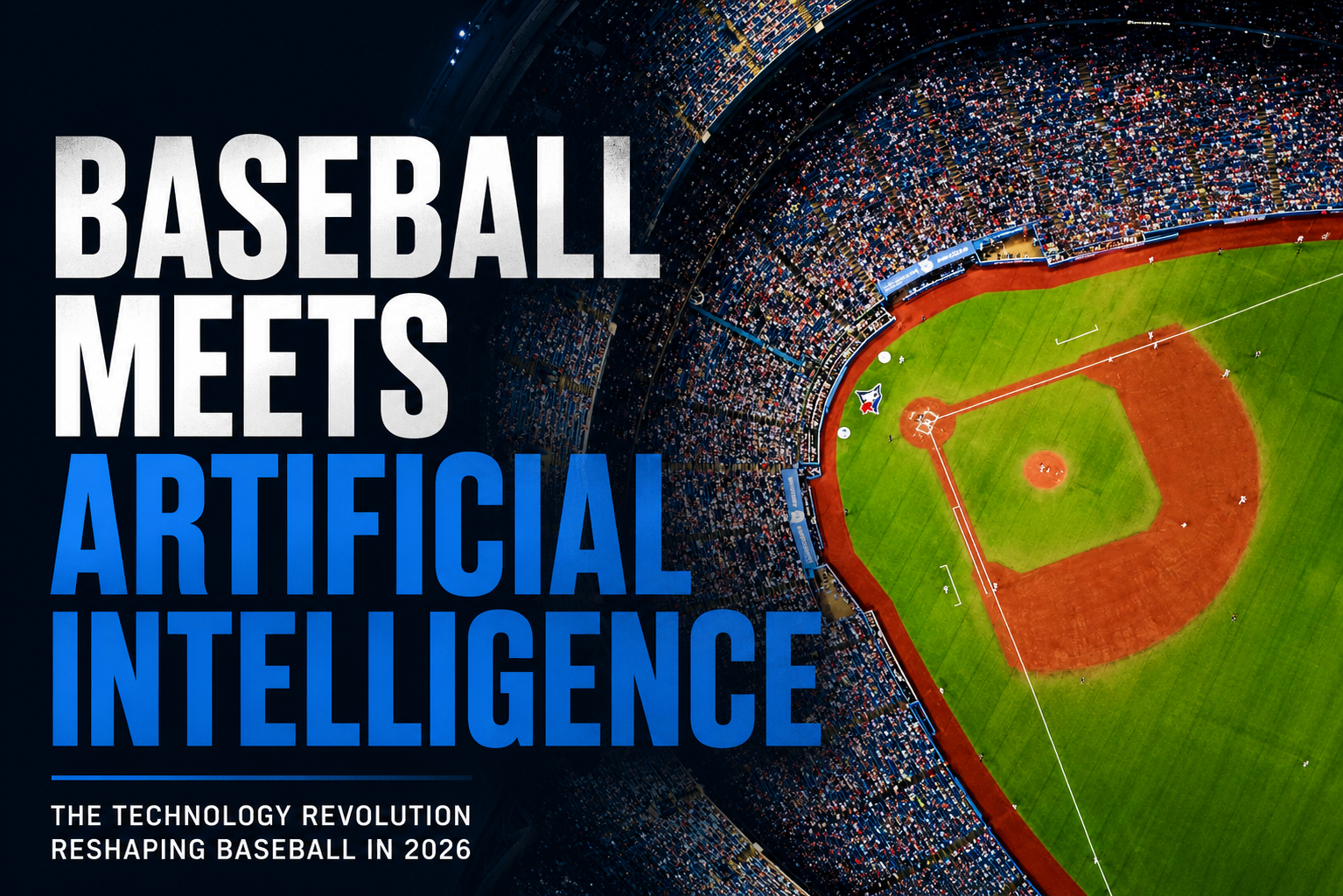
Baseball Meets Artificial Intelligence
The Technology Revolution Reshaping Baseball in 2026
The Game Is Entering a New Era
Baseball has always been a sport that respects its history. Long before television broadcasts, advanced statistics, and billion-dollar media deals, the game was built around a simple contest between pitcher and hitter. Generations of fans grew up watching legends step onto the field and create moments that became part of baseball folklore. While the uniforms, stadiums, and athletes have changed over the years, the essence of the sport has remained remarkably consistent. That deep connection to tradition is one of the reasons baseball continues to occupy a unique place in American culture. Yet even a sport known for preserving its past cannot ignore the future forever, and in 2026 that future is arriving faster than ever before.
The modern game is experiencing a technological transformation unlike anything seen in previous generations. Artificial intelligence, advanced tracking systems, wearable devices, virtual reality training, and automated officiating technology are now influencing decisions at every level of professional baseball. What was once a sport driven primarily by instinct, experience, and observation has become one of the most data-rich environments in professional sports. The changes are not merely happening behind closed doors in front offices and research departments. Fans can now see technology influencing games in real time, making 2026 one of the most significant turning points in baseball's long history.
The Technology Every Baseball Fan Is Talking About
No innovation has captured more attention this season than Major League Baseball's Automated Ball-Strike Challenge System. For more than a century, arguments over balls and strikes have been part of the game's identity. Players have slammed helmets, managers have been ejected, and fans have spent decades debating whether a pitch clipped the corner of the strike zone. Entire games have been remembered because of a single controversial call. In many ways, disagreements over balls and strikes became as much a part of baseball culture as the game itself. While technology has transformed many aspects of sports, the strike zone remained one of the last major areas governed entirely by human judgment.
That changed in 2026 when MLB officially introduced the ABS Challenge System. Rather than replacing umpires completely, the league adopted a hybrid approach that allows players to challenge specific calls they believe were incorrect. Within seconds, advanced technology determines whether the pitch was actually a ball or a strike. The result is displayed for everyone to see, creating a level of transparency that baseball has never experienced before. Fans inside the stadium and viewers watching at home are no longer left wondering whether a call was correct. Technology provides an immediate answer, turning one of the sport's oldest debates into one of its newest innovations.
How Artificial Intelligence Powers The Strike Zone
The ABS system may appear simple to fans, but the technology behind it is extraordinarily sophisticated. Every pitch thrown during a Major League Baseball game is tracked by a network of cameras and sensors capable of measuring the baseball's exact location as it travels toward home plate. Artificial intelligence processes this information almost instantly, comparing the pitch's path to a digitally defined strike zone. Because the strike zone is customized to each player's height, the technology must make complex calculations in real time while maintaining remarkable accuracy.
The importance of this system becomes easier to understand when considering how difficult it is for a human umpire to call pitches consistently. A baseball traveling ninety-five miles per hour reaches home plate in less than half a second. Umpires must judge velocity, movement, and location simultaneously while maintaining focus for an entire game. Even the most experienced officials occasionally miss calls. Artificial intelligence does not become distracted, tired, or influenced by crowd noise. It evaluates each pitch using the same standards every time. While the technology is not replacing human officials, it is providing a level of consistency and precision that was previously impossible to achieve.
Why MLB Chose Challenges Instead Of Robot Umpires
One of the most fascinating aspects of baseball's technological evolution is the league's decision not to fully automate ball and strike calls. For years, fans debated whether robot umpires would eventually replace humans behind home plate. Many expected Major League Baseball to adopt a completely automated strike zone once the technology became reliable enough. Instead, league officials chose a more balanced approach that preserves the role of the umpire while allowing technology to correct mistakes when necessary.
This decision reflects baseball's ongoing effort to modernize without abandoning the traditions that make the sport unique. Human umpires remain an important part of the game, bringing personality, experience, and judgment to every contest. At the same time, players and fans increasingly expect accuracy when technology is capable of providing it. The challenge system represents a compromise between those two priorities. Most pitches are still called by human officials, but technology is available when a critical mistake occurs. In many ways, the ABS Challenge System represents baseball's broader philosophy toward innovation: embrace technology where it improves the game while preserving the human elements that fans continue to value.
Data Has Become Baseball's Most Valuable Resource
Long before fans began discussing ABS challenges, artificial intelligence had already transformed baseball behind the scenes. Every game produces an extraordinary amount of information. Each pitch generates data about velocity, movement, release point, and spin rate. Every swing creates measurements related to bat speed, launch angle, and contact quality. Defensive players are tracked as they move across the field, allowing teams to analyze positioning, reaction times, and efficiency. What once required hours of manual observation can now be measured automatically with remarkable precision.
The challenge facing teams is no longer collecting information. The challenge is understanding it. Artificial intelligence has become essential because it can analyze millions of data points and identify patterns that human analysts might never notice. Teams use machine learning systems to evaluate opponents, develop game plans, and identify opportunities for improvement. Front offices rely on predictive models when making roster decisions, while coaches use advanced analytics to help players refine their skills. In modern baseball, information has become one of the most valuable assets an organization can possess, and artificial intelligence is the tool that turns that information into actionable insights.
The Rise Of The Digital Athlete
The players themselves are becoming increasingly connected to technology. Wearable devices now monitor heart rate, sleep quality, recovery levels, workload, and overall physical readiness. These tools provide teams with a detailed understanding of how athletes respond to training, travel, and competition. Instead of relying solely on observation or self-reporting, coaches can access objective information that reveals when a player may need additional recovery or when they are prepared to perform at their highest level.
This shift reflects a larger change in professional sports. Teams increasingly view player health as one of their most important investments. Injuries can dramatically impact a season, especially when they involve star players earning significant salaries. By monitoring physical performance more closely, organizations hope to reduce injury risk while maximizing long-term productivity. Technology cannot eliminate injuries entirely, but it can provide valuable information that helps teams make smarter decisions. As wearable technology continues to improve, its role in player development and health management is likely to become even more important.
Virtual Reality Is Changing Preparation
Baseball has always been a game of repetition. Hitters improve by seeing pitches, pitchers improve by throwing them, and fielders improve through practice and experience. The challenge is that physical repetition often comes with physical wear and tear. Virtual reality offers a new approach by allowing players to train in highly realistic digital environments without placing additional stress on their bodies. A hitter can face a virtual version of an opposing pitcher and study pitch movement, release points, and tendencies before stepping into the batter's box during an actual game.
The value of this technology extends beyond convenience. Virtual reality allows players to accumulate mental repetitions at a scale that would be difficult to achieve through traditional methods. Athletes can prepare for specific opponents, rehearse different scenarios, and refine decision-making skills in a controlled environment. As the technology continues to improve, many experts believe virtual reality will become a standard component of professional sports training. For baseball players seeking every possible advantage, the ability to practice against realistic simulations may prove just as valuable as traditional batting practice.
A Smarter Experience For Fans
Technology is not only changing how baseball is played. It is also changing how baseball is experienced. Modern broadcasts provide fans with information that previous generations could never have imagined. Viewers can watch pitch movement in real time, track exit velocities after every hit, and analyze defensive positioning through advanced graphics. Statistics that once existed only within team front offices are now displayed during national broadcasts and discussed as part of everyday baseball conversations.
The stadium experience is evolving as well. Enhanced connectivity, mobile applications, interactive features, and real-time data access are creating new opportunities for engagement. Fans are no longer limited to watching the action unfold on the field. They can explore the game through multiple layers of information that provide deeper insight into what they are seeing. Technology has transformed baseball from a simple spectator sport into a more interactive and informative experience, helping attract a new generation of fans while giving longtime supporters new ways to appreciate the game.
The Future Of Baseball Has Arrived
The relationship between baseball and artificial intelligence is still in its early stages. Future innovations will likely include even more advanced predictive analytics, improved injury prevention systems, smarter training tools, and increasingly sophisticated forms of player evaluation. The pace of technological development shows no signs of slowing, and baseball organizations will continue searching for new ways to gain competitive advantages through innovation. What seems advanced today may eventually become as ordinary as the radar gun or video replay.
What makes 2026 such an important year is that fans can finally see these changes happening in real time. Artificial intelligence is no longer hidden inside research departments or analytics offices. It is visible every time a player challenges a strike call, every time a broadcast displays advanced tracking data, and every time a team uses technology to improve performance. Baseball remains a game defined by competition, skill, and human achievement, but it is now supported by tools that previous generations could scarcely imagine. The smartest era in baseball history is no longer approaching. It has already begun, and its influence will continue shaping the sport for years to come.